
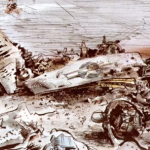
December 7 is Pearl Harbor day; what about the attack on the Philippines a few hours later?
Growing up in America, December 7th was burned into my mind as the “day that will live in infamy”, as indeed it was. The attack on Pearl Harbor was a horrific blow on the United States that knew no equal until September 11, 2001. But the Philippines was part of the United States in 1941, and the attack on the Philippines followed within hours of the attack on Pearl Harbor.
Here is a careful, concise account of what happened in the Philippines in the hours after Pearl Harbor:
The Attack on the Philippines
News of the attack at Pearl Harbor arrived in the Philippines at 3 a.m. local time — 8 a.m. Hawaii time — but not to MacArthur or any other army officer. An army radio operator on watch heard of the attack while listening to a California radio station. He called his superior, who called another superior, and within a few minutes MacArthur was awakened by telephone. By 3:40 he was rushing to get dressed. At 5:30 he received a radio gram notifying him that the United States and Japan were at war.
The Japanese at their base in Formosa (Taiwan) were worried that an air strike from the Philippines would arrive in retaliation for the attack on Pearl Harbor, but no strike came. MacArthur believed that he was under explicit orders not to initiate hostilities against the Japanese and he denied General Brereton, at Clark Field (fifty miles northwest of Manila), permission to attack with his B-17s.
Arriving that morning from General Arnold was a command to avoid the mistake made at Pearl Harbor by dispersing aircraft on the ground. A report also arrived from a local radar station that unidentified aircraft were headed for Manila and Clark Field. General Brereton ordered thirty-six P-40 fighter planes into the air and seventeen of his B-17s to cruise out of harms way. The approaching Japanese planes changed course. The P-40 pilots could not find them and thought they had been sent up on a false alarm and returned to base, believing perhaps that the attack on Pearl Harbor had been a hoax and that they were being tested for readiness. The B-17s also returned to base.
Around noon the radar station sent another warning to Clark Field, by teletype, but the teletype operator was out to lunch. The radar station sent a message by radio, but the transmission was made unclear by static. A radar officer telephoned a lieutenant at the base, and the lieutenant promised to pass the word along “at the earliest opportunity.” [note] A few minutes later a radio station being listened to during lunch announced “an unconfirmed report” that Clark Field was being bombed. The people who heard this news laughed. Then they began to hear a low moaning sound, which grew louder and louder. The Japanese were attacking with 181 Mitsubishi bombers and 84 Zero fighter-bombers. Base personnel had no air raid shelter or slit trenches to dive into. Only four planes managed to get off the ground. Most of the anti-aircraft rounds that ground crews managed to fire were old and exploded from two to four thousand feet short of the Japanese planes. The Japanese bombed and strafed Clark Field for a little more than an hour and then left, leaving the base in total ruin. Most of MacArthur’s aircraft had been destroyed on the ground. MacArthur was dismayed and wondered whether it had been Germans flying the Japanese planes.
On the same morning that the Japanese attacked Pearl Harbor and the Philippines, they moved against the British at Hong Kong. And on that day they move into Southeast Asia’s only independent country, Thailand, and against the British on the Malay Peninsula — Saigon having been a staging area for these two assaults.
Japan had asked Italy and Germany to join them in their war against the United States, and they did so. Hitler was eager to declare war on the United States before the United States declared war on Germany, and he did so on December 9. When he spoke to parliament (the Reichstag) on the 11th, that rubber-stamp body responded with jubilation. The war that Roosevelt wanted with Germany had come to be — as Germany’s doing rather than Roosevelt’s.
On December 10, Japanese troops invaded Guam and landed at various points in the Philippines, including Luzon and Mindanao. On December 15 they landed against the British in northern Borneo — that area important to them because of its oil. The Japanese in mid-December were fighting to take Hong Kong. On Luzon, meanwhile, the Japanese forces numbered around 50,000 — half the number of those fighting under MacArthur. But they swept MacArthur’s force aside, and on the afternoon of the 22nd they pushed MacArthur and company out of Manila. MacArthur’s forces — 15,000 U.S. troops and 65,000 Filipinos — withdrew to the Bataan Peninsula, across the bay and twenty miles west of Manila, where they lacked food and the Americans called themselves the Battling Bastards of Bataan.
MacArthur made his headquarters on the island of Corregidor, at the mouth of Manila Bay and three miles from Bataan’s coast. He was hoping for relief in the form of the Soviet Union entering the war against Japan. Roosevelt urged this from the Russians, but the Russians were busy enough fighting the Germans and not about to break their non-aggression agreement with Japan.
On December 22, while fighting was still taking place in Borneo, Wake Island fell to the Japanese — Japan’s second assault on that island — its first assault repelled by the Marines there. In mid-January, the Americans on Bataan were forced to retreat to Corregidor. By mid-February the Japanese, on bicycles, had fought their way to the southern end of the Malay Peninsula. The British at Singapore had not been prepared to defend themselves from an assault by land, through the jungles of the Malay Peninsula. They had foreseen a threat only by naval forces, and much of their navy was involved in the war against Germany, far away. And the Japanese had air superiority.
Share this:

If you enjoyed this article, please consider sharing it!



facebook auto poster software
saved drafts on facebook
Obat Untuk Kutil Pada Kelamin
(misalnya
Penyebab Kencing Sakit Keluar Nanah Dan Cara Mengobatinya
Sebaiknya
Obat Tradisional Buat Kutil Kelamin
jika
Obat Medis Untuk Kutil Kelamin
agar} merupakan cara terbaik untuk mencegah penularan kutil kelamin. lunak Namun jika Anda tidak mampu melakukannya, terlebih lagi kutil jika Anda berada dalam usia yang aktif secara cairan, penggunaan kondom bisa dijadikan langkah pencegahan penularan…
Obat Kutil Kelamin Di Apotik
agar} merupakan cara terbaik untuk mencegah penularan kutil kelamin. makin Namun jika Anda tidak mampu melakukannya, terlebih lagi membunuh jika Anda berada dalam usia yang aktif secara efek, penggunaan kondom bisa dijadikan langkah pencegahan penulara…
Obat Generik Untuk Kutil Kelamin
kelamin)
ObatKutilKelaminDenature,AkibatKutilKelamin,BahayaKutilKelamin,BahayakahKutilKelamin,BentukKutilKelamin,BahayaKutilKelaminYangTumbuhDiPenisAtauVagina,CaraMenghilangkanKutilKelamin,CaraMengobatiKutilKelamin,CaraMenyembuhkanKutilKelamin,CiriKutilKelami…
gatal
Obat Yang Tepat Untuk Infeksi Saluran Kencing
Sebaiknya
Obat Nyeri Infeksi Saluran Kencing
kelamin
kencing nanah obat
(misalnya
penyebab kencing nanah pada wanita
Hallo Very useful. denature Indonesia yaitu sebuah perusahaan yang fokus dalam bidang obat herbal aman dan ampuh tanpa efek samping. obat kami sangat mujarab, thanks i like your website. Success always broder
apakah kencing nanah menular
Hai This is my first time visit at here and i am in fact happy to read all at single place. i particularly like about the picture / article / presentation that you describe. Very unique. de Nature ialah sebuah CV yg berjalan dalam bidang pengobatan ala…
obat kencing nanah apotik
Hallo This is my first time visit at here and i am in fact happy to read all at single place. i particularly like about the picture / article / presentation that you describe. Very useful. denature Indonesia yaitu sebuah perusahaan yang fokus dalam bid…
Obat Kutil Kelamin Terbaik
Hallo This is my first time visit at here and i am in fact happy to read all at single place. i particularly like about the picture / article / presentation that you describe. Very useful. denature Indonesia yaitu sebuah perusahaan yang fokus dalam bid…
Jual Obat Kutil Kelamin
Hallo This is my first time visit at here and i am in fact happy to read all at single place. i particularly like about the picture / article / presentation that you describe. Very interesting. denature adalah sebuah perusahaan yang bergerak dalam bida…
Cara Menyembuhkan Kutil Kelamin
Hai This is my first time visit at here and i am in fact happy to read all at single place. i particularly like about the picture / article / presentation that you describe. Very unique. de Nature ialah sebuah CV yg berjalan dalam bidang pengobatan ala…
Obat Menyembuhkan Kutil Kelamin
Hallo This is my first time visit at here and i am in fact happy to read all at single place. i particularly like about the picture / article / presentation that you describe. Very useful. denature adalah sebuah perusahaan yang fokus dalam bidang obat…
Cara Menghilangkan Kutil Kelamin
Hai This is my first time visit at here and i am in fact happy to read all at single place. i particularly like about the picture / article / presentation that you describe. Very unique. de Nature ialah sebuah CV yg berjalan dalam bidang pengobatan ala…
Faktor Kencing Sakit Keluar Nanah
Hallo This is my first time visit at here and i am in fact happy to read all at single place. i particularly like about the picture / article / presentation that you describe. Very unique, interesting and useful. denature Indonesia yaitu sebuah perusah…
agen obat kencing nanah di buton ada tidak
Hai i particularly like about the picture / article / presentation that you describe. Very unique, interesting and useful. de Nature Indonesia merupakan sebuah CV yg bergerak dalam bidang pengobatan alami aman
obat buat kencing nanah
Hallo i particularly like about the picture / article / presentation that you describe. Very unique, interesting and useful. denature adalah sebuah perusahaan yang bergerak dalam bidang obat herbal aman dan ampuh tanpa efek samping. Obat kami sangat ma…
Find more there:
[…]you make blogging glance[…]