
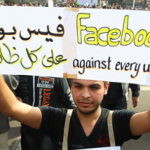
Libya, Egypt: Will This Be Remembered as The Facebook Revolution of 2011?
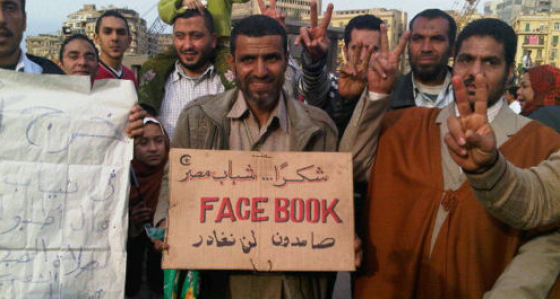
Years from now, will the stunning wave of change that is rolling through Egypt, Libya, and much of the middle east be remembered as the Great Facebook Revolution of 2011? Will it be that, looking back, this will be seen as the point where social media came of age as the the ultimate and definitive force for justice and social change? I think it may well turn out that this is the case, and I think the implications go far beyond the middle east and far beyond Facebook. I think that maybe, just maybe, social media has fueled what will in the time of our grandchildren and their children be seen as a tipping point in which the era of despots and dictators finally went the way of the dinosaurs, and it will be social media that not only sent the tyrants packing, but left behind it a changed world where the People truly do have the Power to hold their leaders accountable in ways that were never possible until now. These are heady days indeed — even as Tripoli remains un-liberated and Khadaffy has the power to wreak mayhem. But the final outcome is not in doubt–the force unleashed by social media cannot be stopped now, even by shutting down the internet in Libya. The genie is out of the bottle and it’s not going back in.
That this this should happen the in Middle East makes it all the more stunning. Ever since the 1990’s, and certainly since 9/11/2001, the broad middle eastern narrative has been about the rise of violent fundamentalism: Al Qaeda, Taliban, Wahhabism have been the watchwords. And yet watching the revolutions unfold in Egypt, Bahrain, and now Libya, it has been stunning to see the power of the entirely secular, humanistic nature of the movement. This is not religious; it’s not even political; it’s simply, heart breakingly human. The battle cry, heard time and again: “I just want to live a normal life.” And it’s Facebook, more than any other single factor, that has given people a sense of what a “normal life” reasonably ought to be.
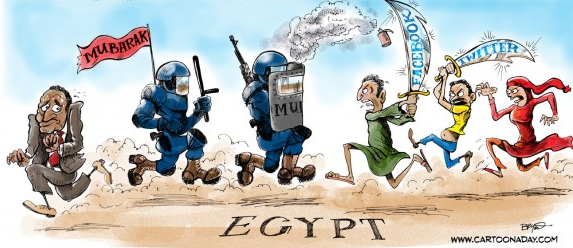
Think about that for a second. To live a normal life. Again and again over the past three weeks that has been the definitive statement from protestors. Yes, there have been those crying out for democracy and it’s clear that freedom and democracy are goals of the movement. But even before that there seems to be a simple cry coming from people who–in large part because of social media — had a shared universal idea of what a “normal life” is, or should be; who feel connected through social media to an online shared “nation” where, they realize, the conditions they live under in their physical domain are not “normal”, and are not acceptable. And with the connectedness that social media brings them — it is possible to rally, organize, and be unafraid in ways that were never possible before.
 Putting it In Perspective
Even before Facebook and Twitter became the force that they have grown into, the web created the opportunity for the “wired” among us to find and participate in communities that were as real for us as the physical communities we inhabit — and which are not bound by geography but rather are bound by a shared idea, a shared passion. Virtual communities began to mean as much, or more, really, than geographical communities. I mean — do you feel more in common with people simply because they inhabit the same general geographic space that you do, or do you feel more in common because they share values, ideas, and interests? I say this without meaning to belittle or minimize the value of physical community –particularly in the types of smaller communities where the bonds truly are meaningful. But as an urban dweller in a major metropolis who has no idea who my physical neighbors are, it has become increasingly clear that the online communities that I’m part of mean more to me than geography. Until, that is, something like what happens in the middle east occurs — where the only pulse electrifies the physical communities with a sense of shared experience, and shared hope — shared possibility, and the means to organize and bring about change.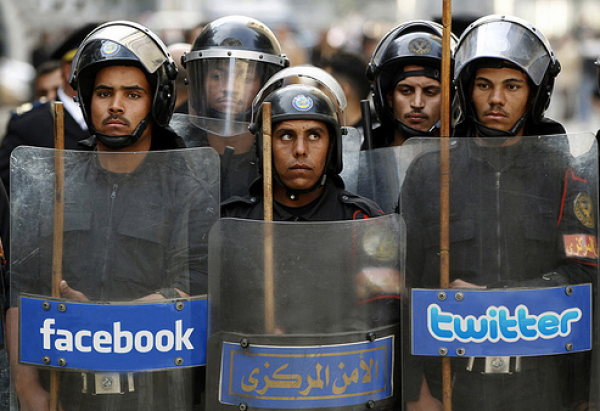
That, ultimately, is what we’re seeing happen — the channeling of online information in such a way as to connect people, inspire them, give them courage — a means to organize, and a means to witness, in front of the world, the playing out of the revolution in a way that has never been possible before. Even Khadaffy, with all the mechanisms of control that he has and is willing to exercise, has been unable to stop the flow of social media images and information out of Tripoli even as he’s clamped down on mainstream media. How many times in the last ten days have I seen “From Facebook” in the corner of the screen on CNN or BBC World as the MSM pulls its truth from the world of social media.
Most of the time Facebook, with 600 million members, is too large and too diverse to feel like one community — but at moments like this, it does feel to me that the “Facebook Nation” is, in a way, a superpower “nation” with no army, no weapons, no structure, really — but a nation nonetheless where there is a shared sense of connectedness and, perhaps, certain broadly shared values having to do with the right to communicate; to connect; to live a life that isn’t defined so much by economic status or geographic location, but just by a simple sense of freedom “froms” and freedom “to’s” — freedom from fear, hate, tyranny, and freedom to create, connect, express — live that elusive “normal life” that everyone seeks.
The Beginning of the End of Al Qaeda?
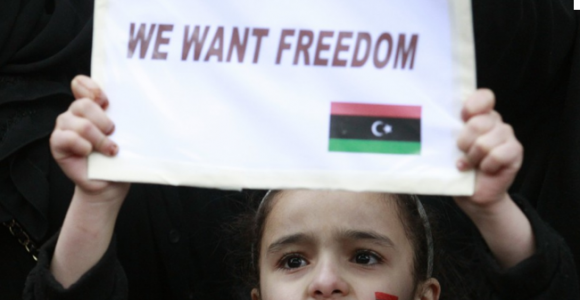
I wonder if, years from now, this will also be seen as the beginning of the end of Al Qaeda and the wave of fundamentalism that has dominated the narrative for the past decade. I was struck by the remarkable young woman from Libya interviewed by Anderson Cooper on February 25th: “We have no al-Qaeda, I don’t want to say we are not religious. I don’t want to hurt anybody’s feelings. But we are very peaceful, middle people, we just care about normal living — eating, sleeping. We are living a life. We don’t have good education. We don’t have health care. People are concerned…we are barely just surviving. We don’t have any of the crazy ideas. What is Al Qaeda …we don’t want that.” If hers were a voice in isolation it would be important to not read too much into it, but there have been many like her saying much the same thing. I can’t help but wonder — if the revolution gives a sense of hope, of possibility for the future, of the possibility of a ‘normal’ life–isn’t it the absence of that hope that has been the fertile soil into which the seeds of fundamentalism are planted. And if there is hope for a “normal” life — a good job, health care, education — all the things the Libyan woman a talked about — will that soil remain fertile? Only time will tell, and it is always a dangerous thing to try and extract deeper meaning from a moment that is only now playing out in history. But the meaning is there, and we should celebrate it –cautiously to be sure, and with a proper sense of wariness that maybe it won’t be a straight path–but nevertheless, the world is moving in a positive direction and social media is the force that it is ennabling this to happen. It’s nice to be a tiny little part of it.
Share this:

If you enjoyed this article, please consider sharing it!



Look there for more:
[…] What host are you the use of? Can I am getting your associate link for your host? I desire my website loaded up as fast as yours lol[…]
…Websites you should visit
[…]I am no longer certain the place you’re getting your information, but great topic.[…]